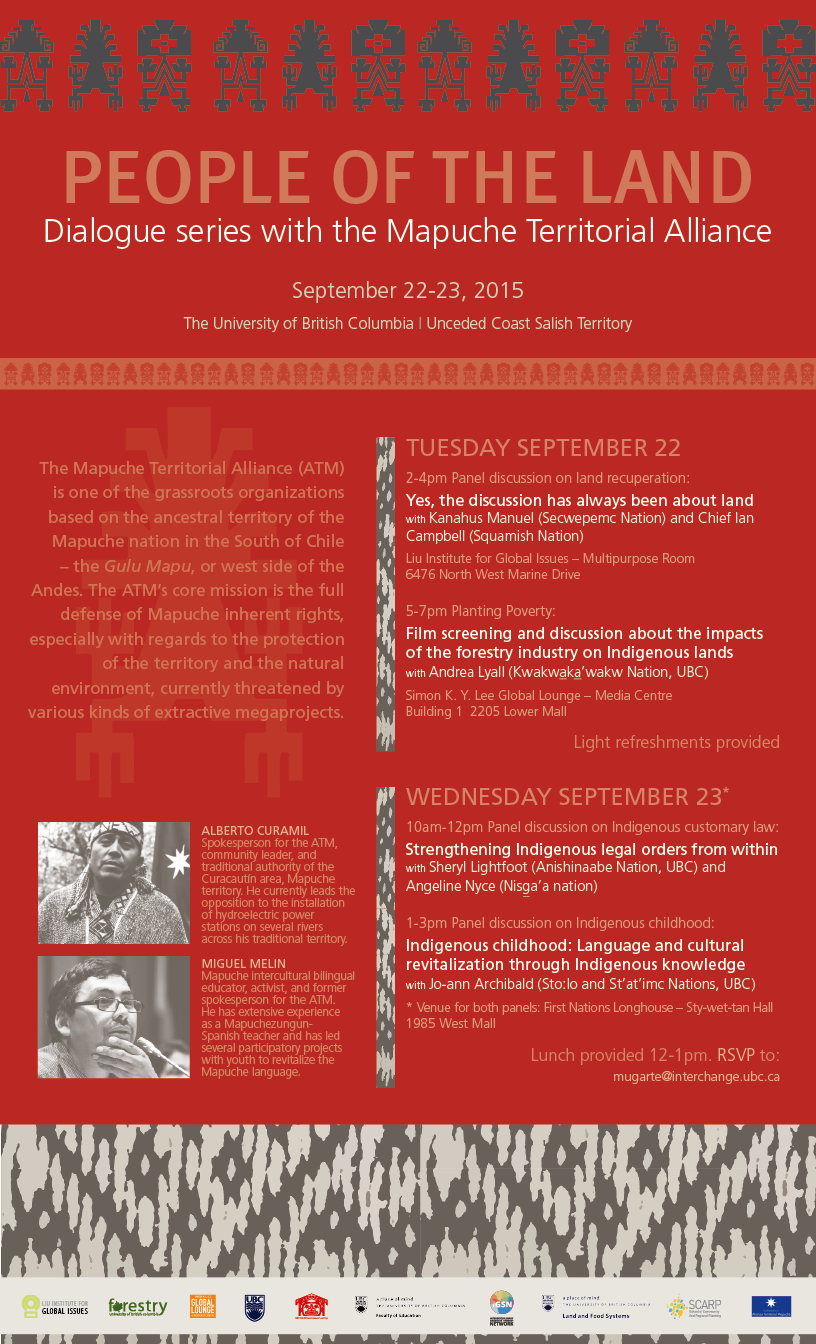
People of the Land: Dialogue series with the Mapuche Territorial Alliance September 22-23

ATM Visit 2015

People of the Land: 

Dialogue series with the Mapuche Territorial Alliance

September 22-23, 2015

UBC | Unceded Coast Salish Territory


People of the Land: Dialogue series with the Mapuche Territorial Alliance will bring together two Indigenous leaders from the Mapuche Nation –Alberto Curamil and Miguel Melin– with Indigenous activists and scholars from North America to exchange ideas and share experiences about land recuperation, opposition to extractive industries on their traditional territories, customary law, and Indigenous childhood, language, and education.


The Mapuche Territorial Alliance (ATM) is one of the grassroots organizations based on the ancestral territory of the Mapuche Nation in the South of Chile – the Gulu Mapu, or west side of the Andes. The ATM’s core mission is the full defense of Mapuche inherent rights, especially with regard to the protection of the territory and the natural environment.


Everyone is welcome, but RSVP is required for the lunch on September 23rd.


TUESDAY SEPTEMBER 22

2-4pm Panel on land recuperation: Yes, the discussion has always been about land

With Kanahus Manuel (Secwepemc Nation) and Chief Ian Campbell (Squamish Nation)

Liu Institute for Global Issues – Multipurpose Room

6476 North West Marine Drive


5-7pm Planting Poverty: Film screening and discussion about the impacts of the forestry industry on Indigenous lands

With Andrea Lyall (Kwakwa̱ka̱ʼwakw Nation, UBC)

Simon K. Y. Lee Global Lounge – Media Centre

Building 1  2205 Lower Mall


Light refreshments provided


WEDNESDAY SEPTEMBER 23*

10am-12pm Panel on Indigenous customary law: Strengthening Indigenous legal orders from within

With Sheryl Lightfoot (Anishinaabe Nation, UBC) and Angeline Nyce (Nisg̱a’a nation)


1-3pm Panel on Indigenous childhood: Language and cultural revitalization through Indigenous knowledge 

With Jo-ann Archibald (Sto:lo and St’at’imc Nations, UBC)


* Venue for both panels: First Nations Longhouse – Sty-wet-tan Hall

1985 West Mall


Lunch provided 12-1pm. RSVP to: mugarte@interchange.ubc.ca


Alberto Curamil is the spokesperson for the ATM. Community leader and traditional authority of the Curacautin area, Mapuche territory, he currently leads the opposition to the installation of hydroelectric power stations on several rivers across his traditional territory.


Miguel Melin is a Mapuche intercultural bilingual educator, activist, and former spokesperson for the ATM. He has extensive experience as a Mapuchezungun-Spanish teacher and has led several participatory projects with youth to revitalize the Mapuche language.


Presented with support from the Liu Institute for Global Issues, the Faculty of Forestry, the First Nations House of Learning, the Global Lounge, the Walter H. Gage Memorial Fund, the Faculty of Education, the Interdisciplinary Graduate Students Network, the Faculty of Land and Food Systems, and the School of Community and Regional Planning.
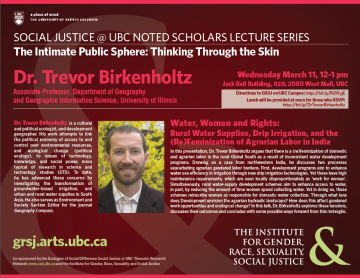
Dr. Trevor Birkenholtz – March 11

11026315_962913387055064_6622080984961363598_n

Water, Women and Rights: Rural Water Supplies, Drip Irrigation, and the (Re)Feminization of Agrarian Labor in India

In this presentation, Dr. Trevor Birkenholtz argues that there is a (re)feminization of domestic and agrarian labor in the rural Global South as a result of inconsistent water development programs. Drawing on a case from northwestern India, he discusses two processes exacerbating agrarian gendered labor burdens. First, development programs aim to enhance water use efficiency in irrigation through new drip irrigation technologies. Yet these have high maintenance requirements, which are seen locally disproportionately as ‘work for women’. Simultaneously, rural water-supply development schemes aim to enhance access to water, in part, by reducing the amount of time women spend collecting water. Yet in doing so, these schemes reinscribe women as responsible for domestic water collection. Through what lens does Development envision the agrarian hydraulic landscape? How does this affect gendered work opportunities and ecological change? In this talk, Dr. Birkenholtz explores these tensions, discusses their outcomes and concludes with some possible ways forward from this imbroglio.

Dr. Trevor Birkenholtz is a cultural and political ecologist, and development geographer. His work attempts to link the political economy of access to and control over environmental resources, and ecological change (political ecology), to issues of technology, knowledge, and social power, more typical of research in science and technology studies (STS). To date, he has advanced these concerns by investigating the transformation of groundwater-based irrigation, and urban and rural water supplies in South Asia. He also serves as Environment and Society Section Editor for the journal Geography Compass.

Lunch will be provided to those who RSVP: http://bit.ly/DrTrevorBirkenholtz
Date and Time: Wednesday, March 11, 12pm
Venue: GRSJ, 2080 West Mall, Room 028
           Jack Bell Building
           University of British Columbia

Directions to GRSJ on UBC Campus: http://bit.ly/R5WyjE

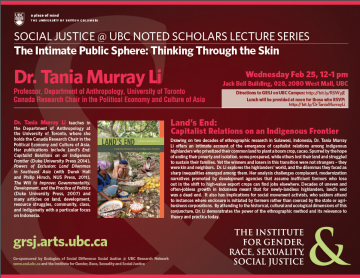
“Land’s End: Capitalist Relations on an Indigenous Frontier” with Dr. Tania Li – February 25 and 26

10359155_958114687534934_9200968012933764508_n

The Ecologies of Social Difference Working Group is hosting Dr. Tania Li from the University of Toronto at UBC on February 25th and 26th. As part of this visit, we’ve organized several events of particular interest for graduate students in addition to her scheduled lecture.

1) Dr Li’s public lecture: “Land’s End: Capitalist Relations on an Indigenous Frontier” will be held from 12:00pm-1:00pm on Wednesday February 25th at the GRSJ Institute, in the Jack Bel Building (2080 West Mall), Room 028. Please RSVP at the following link http://grsj.arts.ubc.ca/rsvp_2015_dr-tania-murray-li. Lunch will be provided to those who RSVP.

2) This lecture will be followed by an informal discussion over coffee with graduate students from 3pm-4:30pm on Wednesday 25th. We anticipate this conversation will focus on common questions such as research design, relations between theory and empirics, and writing for different audiences, although the discussion will primarily be led by graduate students, so bring questions along! Please RSVP to Sophie Webber sphie.webber@geo.ubc.ca if you wish to attend this meeting as we have very few spots left!

3) On Thursday February 26th from 11:00am to 12:30pm we will workshop one of Dr. Li’s recent publications which discusses modern and colonial expertise, neoliberal and liberal government and assemblages, and relations between peoples and lands in the global south. This workshop will be held at the GRSJ Institute, in the Jack Bell Building (2080 West Mall), Room 028. We have a FULL HOUSE for this event, sorry and thank you for  your interest!

International Dimensions of Environmental Justice seminar course with Prof. L. Harris

Spaces still available in this term 2 seminar, open to graduate students and advanced undergraduates. Please feel free to email L. Harris directly with any questions about the course.

lharris@ires.ubc.ca

T2, Winter 2014, Tuesdays, 2-5 pm, 107 AERL, 2202 Main Mall


COURSE DESCRIPTION

This course will investigate the international, and justice, dimensions of a number of environmental issues, with particular attention to the intersection of environmental and developmental concerns.  Focus will also include attention to international institutions, such as the International Financial Institutions, and how such institutions deal with, or contribute to, environmental and developmental justice considerations.  We will also pay particular attention to political economic dimensions of these issues, including histories of colonialism, development, and theories and terms of trade. Students work on a research and/or writing project that investigates a topic of interest, or evaluates a recent monograph or set of films that relate to course themes.

The course has several objectives. It will introduce you to debates in the fields of ‘development’ , ‘political ecology’ and ‘environmental justice.’ It will also expose you to a number of key events and debates critical for understanding international dimensions of environmental justice in the contemporary era.  Further, it will challenge you to develop critical perspectives on environment and development, in addition to gaining familiarity with some of the key concepts, institutions, and processes related to these issues.  Together, we will engage these debates to examine in detail a number of case studies, through readings, mini-lectures, and research activities

Land Trees and Tenure with Prof. Janette Bulkan

Course description

‘European legal theory understood the right of property as the control over things. Since at least Montesquieu, this private right (dominium in Roman law) was contrasted with sovereignty (imperium), or the rule over people. Property belonged to individuals, while sovereignty was the power of the state. But in practice, in both Europe and Egypt, property was a power relation among people as well as things’ (Mitchell, T. Rule of Experts, 2002).

This course – Land, trees and tenure –draws together and systematises the forces that gave rise to the global variety of systems of tenure to trees and to forestlands, and the evolution in the governance of tenure. Tenure refers to the possession or holding of the many rights associated with a parcel of land. These rights are frequently described as a bundle that may be broken up, re-divided, passed on to others, etc., depending on the system of tenure.

This course provides the future forester, land manager or graduate working in any aspect of environmental governance with a background in tenure systems and processes necessary to navigate the complex world of overlapping rights of access to forestlands.

This course provides a historical treatment of the wide variety of legal rules, and regulations that govern access to trees and/or forestlands. We will review the evolution of State and customary rights to land, starting in Europe, and following European expansion to the neo-Europes and the tropics.  We will start with a thorough grounding in the legal concepts of property and tenure as they evolved and differentiated with respect to imperium and dominium.  Through a variety of readings, lectures and discussions, students will consider the forces that favoured or constrained State or customary rights to forests in different historical and geographical contexts. We will analyze the evolution in law and custom that shifted the balance of power and the implications of such shifts for forests and society. Students will gain a strategic understanding of the de-concentration of State control over forests in the 20th century, and the forces that favour State re-centralization in the 21st century. Through case studies, students will examine contemporary tenure issues relating to resource management, overlapping tenures, etc. We will review the safeguards for customary rights to forestlands in a growing body of national legal decisions, and a range of international conventions and declarations and the application of those protections.

Readings will be drawn from law, forestry, history, global environmental politics, political economy and anthropology.

Feb 25, 12pm lecture by Tania Li “Land’s End: Capitalist Relations on an Indigenous Frontier” GRSJ, Room 028 Jack Bell, 2080 West Mall. RSVP to get a free lunch. There will also be another meeting planned with Dr. Li, likely for Thursday. Please attend if possible- details to follow.

An earlier version of Dr. Sandilands talk, delivered at Columbia Univ:

http://vimeo.com/92151781

Botanically Queer: Plants, Sex, and Biopolitics

Screen Shot 2014-09-15 at 3.24.47 PM

Dr. Catriona Sandilands: Professor, Faculty of Environmental Studies, York University

Plants have been profoundly queer players in modern projects of describing “life” for ethical and political consideration. From their taxonomic destabilizations of colonial order in the eighteenth century to their questionings of agency in recent posthumanist discourses, plants demand that we think about living, being, and becoming in ways that interrupt anthropocentric, heteronormative figurings of agency, futurity, and life generally. This presentation will explore “botanical queerness” with an eye to thinking through the complexity of humans’ relations to plants beyond habitual modes of address. Plants are not simply object of human concern; they offer up modes of being, becoming, and living that have been overlooked in more animal-centric accounts, and that point to a more queer and ecological understanding of life in relation to power.

Continue reading “Botanically Queer: Plants, Sex, and Biopolitics”

Watch Vancouver as the Greenest City Panellist Speech

Watch the panellist speech for Vancouver as the Greenest City event online.

Jordan Bober is a New Economist who devotes himself to the evolution of a regenerative, socially just economy by convening events, speaking and teaching, and by running a Vancouver-based community currency called Seedstock.

Melanie Conn is a long-time activist with women, co-operatives and community economic development. She is also a founding director of the Women’s Economic Council.

Stephanie Lim is the coordinator of the Renfrew Collingwood Food Security Institute, and a founding member of the Neighbourhood Food Network Working Group.

Dr. Robert Vanwynsberghe is an Assistant Professor in the Department of Educational Studies at the University of British Columbia. His research expertise is in sustainability and the related areas of social movements and capacity building.

Questions and answers session

Vancouver as the Greenest City? A Social Justice Perspective

IMG_2796


Vancouver as the Greenest City? A Social Justice Perspective:

Panel discussion, Q&A, and a reception following the event. Vancouver is moving rapidly towards becoming the ‘Greenest City’, but what are the implications and opportunities to integrate social justice in these long-term visions of sustainability? What examples are there to date of missed opportunities or key successes towards this end? More broadly, what tools are available to us to better connect social justice and environmental sustainability aims? This panel is organized by the Ecologies of Social Difference Social Justice @ UBC Thematic Network. Our network is interested in promoting insights, research, and networking at the intersection of nature/environment,social justice and difference/inequality.

PANELISTS:

Jordan Bober is a New Economist who devotes himself to the evolution of a regenerative, socially just economy by convening events, speaking and teaching, and by running a Vancouver-based community currency called Seedstock.

Melanie Conn is a long-time activist with women, co-operatives and community economic development. She is also a founding director of the Women’s Economic Council.

Stephanie Lim is the coordinator of the Renfrew Collingwood Food Security Institute, and a founding member of the Neighbourhood Food Network Working Group.

Dr. Robert Vanwynsberghe is an Assistant Professor in the Department of Educational Studies at the University of British Columbia. His research expertise is in sustainability and the related areas of social movements and capacity building.


Free entrance!! Snack and drinks are provided. Please RSVP with esd.ubc(at)gmail.com 

Time: May 22, 2014 at 6 PM

Venue: C680 – HSBC Hall, UBC Robson square, 800 Robson St, Vancouver, BC V6Z 3B7  

See the poster here

When I Wear My Alligator Boots

When I Wear My Alligator Boots

Reading and discussion with Dr. Shaylih Muehlmann, Assistant Professor and Canada research chair in language, culture and environment.

Her recent bookWhen I Wear My Alligator Boots examines how the lives of dispossessed men and women are affected by the rise of narcotrafficking along the U.S.-Mexico border. In particular, the book explores a crucial tension at the heart of the “war on drugs”: despite the violence and suffering brought on by drug cartels, for the rural poor in Mexico’s north, narcotrafficking offers one of the few paths to upward mobility and is a powerful source of cultural meanings and local prestige.


Poster

The event is open to UBC Faculty and guests. No RSVP required. cash beer, wine and tapas.