By kreynol on December 22, 2023
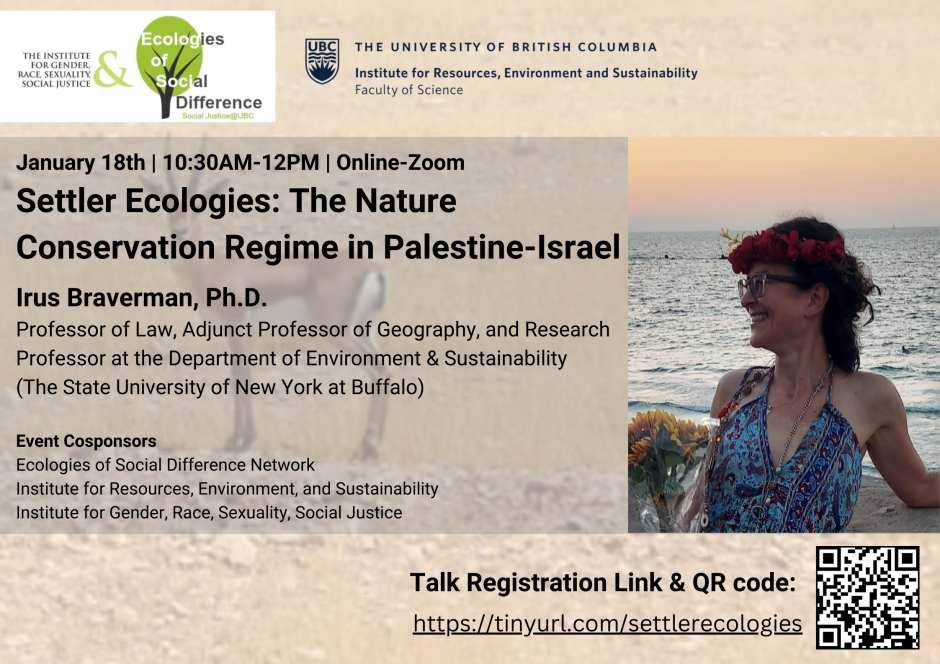
Irus Braverman will join us to discuss her latest book, Settling Nature: The Conservation Regime in Palestine-Israel (2023, University of Minnesota Press). Drawing on more than seventy interviews with Israel’s nature officials and on observations of their work, this book explores the widespread ecological warfare practiced by the state of Israel. Recruited to the front lines as part of this warfare are the fallow deer, gazelles, wild asses, griffon vultures, pine trees, and cows on the Israeli side—against the goats, camels, olive trees, hybrid goldfinches, and akkoub on the Palestinian side. The state’s use of these nonhuman organisms as soldiers in a human war is all the more effective because nature camouflages their tactical deployment as such. At the end of the day, the administration of nature by the state of Israel advances both the Zionist project of Jewish settlement and the corresponding dispossession of non-Jews from this space. Register for the talk HERE
Irus Braverman is professor of law, adjunct professor of geography, and research professor of environment and sustainability at the State University of New York at Buffalo. Her books include Zooland: The Institution of Cabtivity (2012), Coral Whisperers: Scientists on the Brink(2018) and Settling Nature: The Conservation Regime in Palestine-Israel (2023).
Posted in News And Events, Slideshow
By Taya Triffo on March 7, 2022
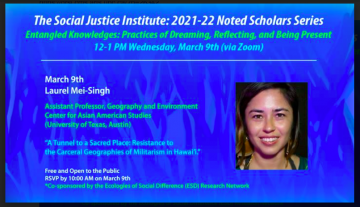
Please consider attending this upcoming talk, which is co-sponsored by the Ecologies of Social Difference Network! “A Tunnel to a Sacred Place: Resistance to the Carceral Geographies of Militarism in Hawai’i.” with Dr. Laurel Mei Singh will be held virtually on Zoom Wednesday, March 9th from 12-1 PM.
Abstract
This presentation will examine the antagonistic relationship between military occupation and locally situated human-environment intimacy that stands central to struggles for healthy livelihoods, environmental justice, and decolonization. Ethnographic and archival research in Hawai‘i, a place critical to US defense strategy, informs a theorization of military fences as a spatial expression of geographies of race and colonialism. They signify the state’s attempts to impose order through strategies of occupation, possession, and differentiation through the production of uneven access to life-giving resources. Yet while Hawai‘i functions as the Pacific Command headquarters that oversee military operations across half the earth’s surface, military presence does not impose unilateral hegemony on the islands. Rather, grassroots collective action that draws from Indigenous paradigms of human-environment connectivity persists and thrives. A Tunnel to a Sacred Place thus affirms the centrality of Hawai‘i and the Pacific to US war making while proposing a theory of Indigenous resistance against and in the shadows of a militarized carceral state.
Posted in News And Events
By Taya Triffo on December 14, 2021
Over the course of the pandemic, the ESD has taken a bit of a rest. The important work of our members, however, has continued, and we are excited to revitalize this group in the coming months. We invite you to consider becoming an ESD network member, or to simply subscribe to our mailing list if you have not already.
Consider subscribing to our UBC mailing list to stay up to date on news, opportunities and events.
To join:
1. Send an email to listserv@lists.ubc.ca with the words subscribe esd-socialjustice in the body.
2. You will receive a confirmation email within a few minutes. Click on the confirmation link within the email
3. You will receive another email to confirm that you are now subscribed to the list
Note: Do not include a signature in the email body. The signature will stop your subscription from going through. The only thing in the body of the email should be the SUBSCRIBE commands.
To unsubscribe:
1. Send an email to listserv@lists.ubc.ca with the words unsubscribe esd-socialjustice in the body
Reach out if you would like to become a member and have your profile featured on our website.
Please email esd.ubc [at] gmail [dot] com to express your interest in making a profile and share the following information: your name, your personal pronouns, a short biography, a profile picture, your UBC departmental affiliation, keywords associated with your research, contact information, a link to your website, and recent publications.
Posted in News And Events, Slideshow
By anna doebeli on February 5, 2020
Ecologies of Social Difference presents:
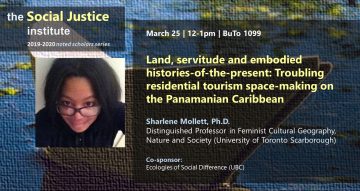
Dr. Sharlene Mollett
“Land, servitude and embodied histories-of-the-present: Troubling residential tourism space-making on Panamanian Caribbean”
When: March 25, 12:00pm
Where: Buchanan Tower, Room 1099
PLEASE NOTE: Regretfully this event has been cancelled due to the University’ closure amid the ongoing Covid-19 situation. Please return to the ESD website soon for more updates on future events.
Abstract:
In this address, I examine the ways in which settler colonial logics shape residential tourism development on the Atlantic Coast of Panama. I entangle feminist political ecological assertions that struggles over nature are embodied struggles, with intersectional and relational understandings of land and body, drawn from a fusion of critical feminist thought. While it is true that settler colonial logics of elimination have gendered implications for indigenous Ngobe women, I focus on Afro-Panamanian women, and illustrate through ethnographic testimonies, the ways in which settler logics of elimination manifest in the naturalization of Afro-Panamanian women as criadas (maids). Such imaginative and material geographies reflect conventional racial-sexual-gendered histories that take for granted black female servitude and landlessness on the Atlantic coast. Thus, I argue that Afro-Panamanian women’s participation in Bocas’ tourism enclave–a project that seeks to erase indigenous and black relations to coastal lands and foster their subjection to foreign settlers–is simultaneously a reflection of their demands to remain on the coast.
About Dr. Mollett:
As a feminist political ecologist and cultural geographer, my work interrogates multiple forms of power shaping land conflicts in Latin America. Drawing insights from postcolonial, decolonial and critical feminist/racial studies in the Americas, my work examines the multiple ways racial and gendered ideologies and logics shape natural resource conflicts embedded in a variety of international development projects, namely, protected area management, land titling and residential tourism in Honduras and Panama. Broadly, my interests include how place-specific representations and meanings of race, gender and sexuality are imbued in land and territorial struggles and how indigenous peoples, Afro-descendants, and non-indigenous campesinos are incorporated within, and resist, elite and state land centered development projects/processes.
Posted in News And Events, Uncategorized
By anna doebeli on February 5, 2020
Ecologies of Social Difference presents:
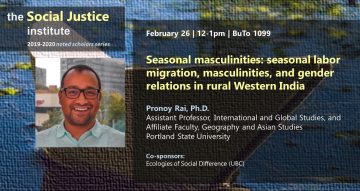
Dr. Pronoy Rai
“Seasonal masculinities: seasonal labor migration, masculinities, and gender relations in rural Western India”
When: February 26th, 12:00pm
Where: Buchanan Tower, Room 1099
Abstract:
In this talk, I examine seasonal labor migration in rural western India to understand gender negotiations in the course of labor migration. Based on qualitative research conducted in rural western India in 2014 and 2015–16, I examine gendered labor in migrant home communities and at various rural and urban employment destinations, the relationship of labor to the social construction of masculinities, and gender negotiations across space. I show that in their home communities, the politics of resistance of returnee laborers can be understood by examining how returnee men deploy ‘protest masculinities’ to subvert claims on their body and labor by elite men. Second, I find that rural workplaces are the preferred choice of destination for migrant women; a choice that migrant men find reasonable because rural destinations are already gendered as spaces conducive for social reproduction and discursively constructed in the same terms as the idealized woman subject.
About Dr. Rai:
Pronoy Rai is an assistant professor of International and Global Studies and an affiliated faculty in Geography and Asian Studies at Portland State University. He received his Ph. D. in Geography from the University of Illinois at Urbana-Champaign in 2018, where he wrote his dissertation on the social geographies of seasonal labor migration in rural western India. Rai was awarded the 2019 J. Warren Nystrom Award by the American Association of Geographers for the best paper based on a dissertation in Geography and his research has received support from the Social Science Research Council, the University of Illinois, and Portland State University.
Posted in News And Events, Uncategorized
By nza on October 30, 2017
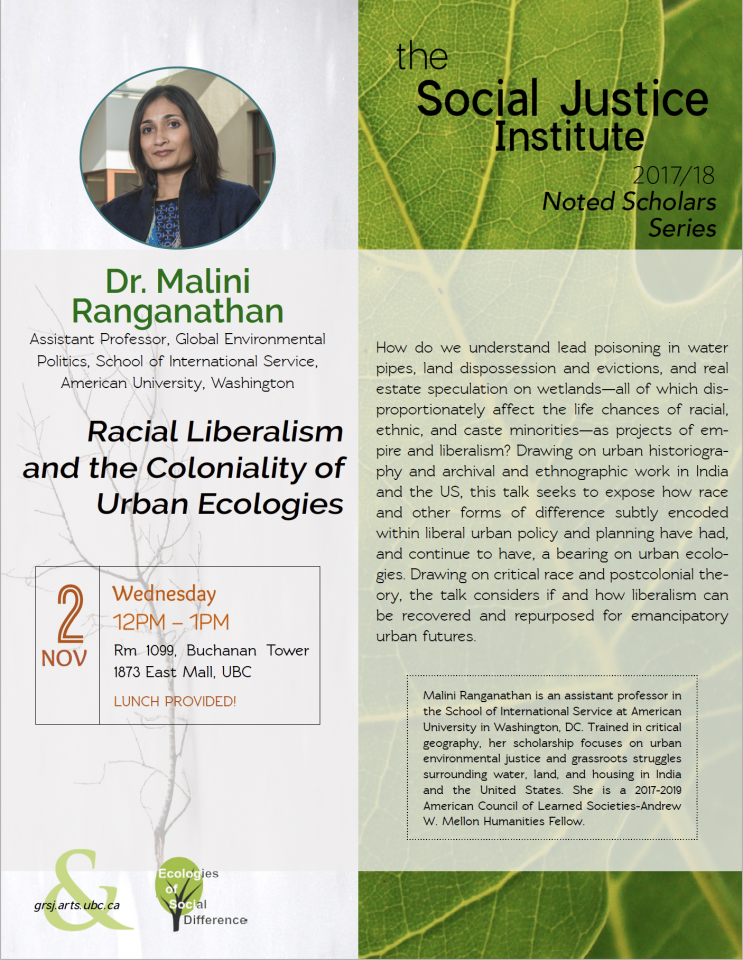
Ecologies of Social Difference and the Social Justice Institute present:
Dr. Malini Ranganathan
Racial Liberalism and the Coloniality of Urban Ecologies
When: Thursday November 2nd, 12-1pm
Where: Rm 1099, Buchanan Tower
1873 East Mall, UBC
Lunch Provided
Synopsis: How do we understand lead poisoning in water pipes, land dispossession and evictions, and real estate speculation on wetlands—all of which dis- proportionately affect the life chances of racial, ethnic, and caste minorities—as projects of empire and liberalism? Drawing on urban historiography and archival and ethnographic work in India and the US, this talk seeks to expose how race and other forms of difference subtly encoded within liberal urban policy and planning have had, and continue to have, a bearing on urban ecologies. Drawing on critical race and postcolonial theory, the talk considers if and how liberalism can be recovered and repurposed for emancipatory urban futures.
Posted in News And Events, Uncategorized
By nza on March 21, 2016
Ecologies of Social Difference Bibliography
The University of British Columbia’s Ecologies of Social Difference Thematic Network (Social Justice @ UBC Network) is pleased to announce the release of an initial draft of an Annotated Bibliography on the intersection of inequality/social difference and critical nature studies/political ecology/environmental justice.
This bibliography highlights academic research that investigates the ways that gender, race, class, caste, and sexuality affect and shape people’s interactions with the environment. The purpose of this bibliography is to provide a resource for scholars interested in issues of social difference, inequality, and critical studies of nature/environment.
Citations have been compiled by searching various online databases. Searches were conducted using combinations of the following terms: gender, feminism, race, racism, class, caste, ethnicity, environment, political ecology, ecology. Abstracts were primarily pulled directly from journals or online publishing resources. We welcome additions to the bibliography. Please email suggestions to esd.ubc@gmail.com. This bibliography is a project of the Ecologies of Social Difference Social Justice Thematic Network at the University of British Columbia. Please see our website for other resources and further details: http://www.esd.ubc.ca
Posted in News And Events, Slideshow, Uncategorized
By nza on February 11, 2016
Ecologies of Social Difference and the Social Justice Institute present:
Dr. Kim TallBear, University of Alberta.
Making Love and Relations Beyond Settler Sexualities
When: Wednesday February 24th, noon
Where: Jack Bell Room 028
This talk—a developing theoretical intervention—will serve as a provocation to think through the entangled politics of ethical non-monogamy, nurturing extended family and tribal kin formations, and critiques of marriage as integral to the settler colonial project. This examination conceives of indigenous kin making—even that which is seen as disrupted by colonialism and trauma—as a set of practices that are potentially more “environmentally sustainable,” as that is broadly conceived. The speaker invites the audience to think through these entangled issues with her.
Posted in News And Events, Uncategorized
By nza on February 4, 2016
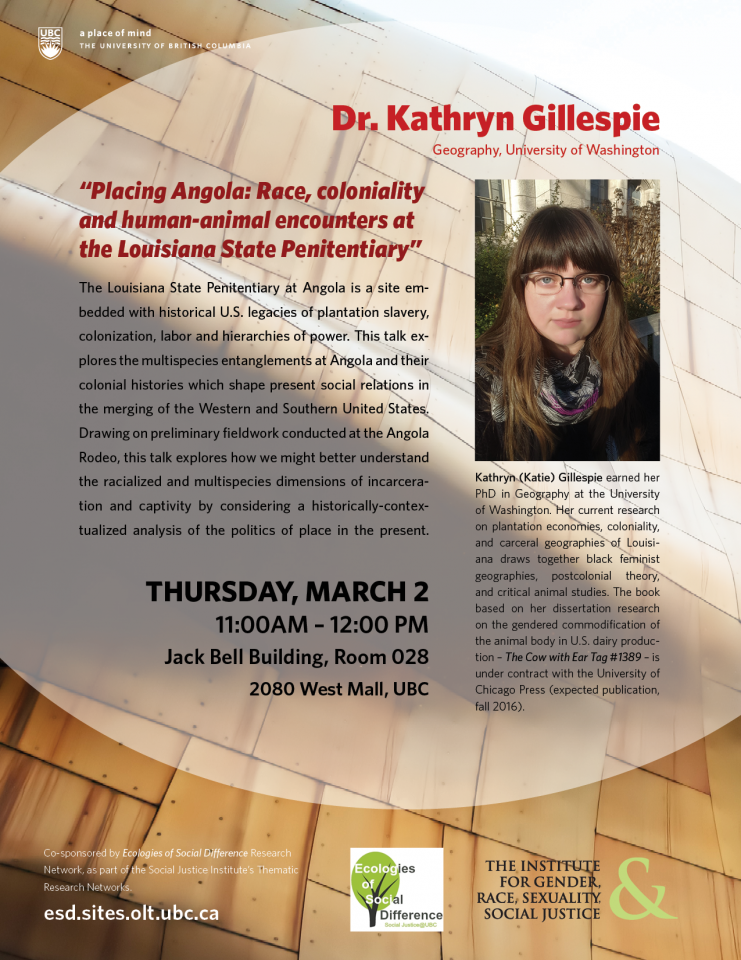
Ecologies of Social Difference and the Social Justice Institute present:
Dr. Katie Gillespie
Placing Angola: Race, coloniality and human-animal encounters at the Louisiana State Penitentiary
When: Mar 3, 11am – 12pm
Where:Room 028, Jack Bell Building
2080 West Mall
The Louisiana State Penitentiary at Angola is a site embedded with historical U.S. legacies of plantation slavery, colonization, labor and hierarchies of power. This talk explores the multispecies entanglements at Angola and their colonial histories which shape present social relations in the merging of the Western and Southern United States. Drawing on preliminary fieldwork conducted at the Angola Rodeo, this talk explores how we might better understand the racialized and multispecies dimensions of incarceration and captivity by considering a historically-contextualized analysis of the politics of place in the present.
Kathryn (Katie) Gillespie earned her PhD in Geography at the University of Washington. Her current research on plantation economies, coloniality, and carceral geographies of Louisiana draws together black feminist geographies, postcolonial theory, and critical animal studies. The book based on her dissertation research on the gendered commodification of the animal body in U.S. dairy production – The Cow with Ear Tag #1389 – is under contract with the University of Chicago Press (expected publication, fall 2016).
Posted in News And Events, Uncategorized
By nza on September 20, 2015
Dear colleagues,
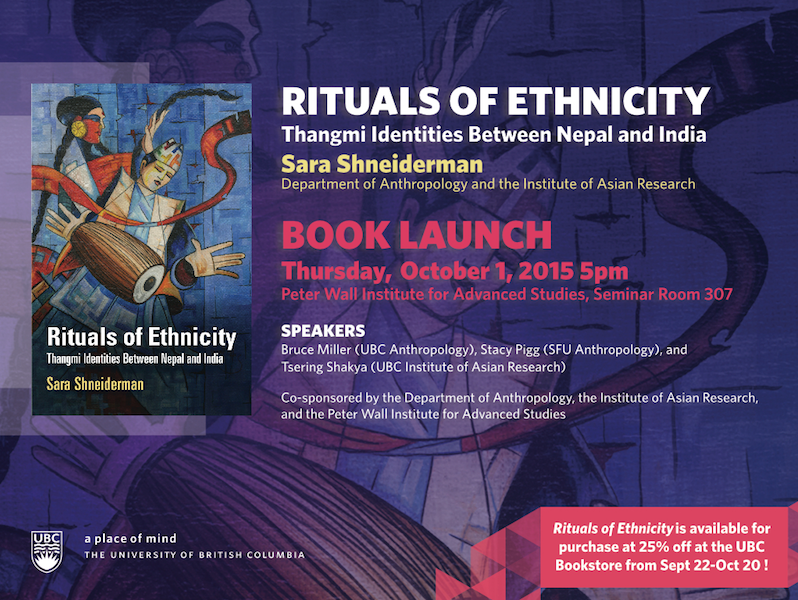
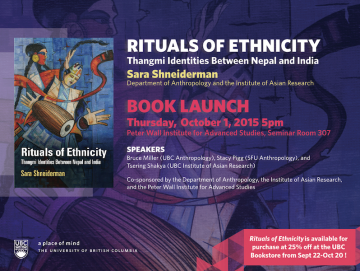
Please join me to celebrate the publication of my new book, Rituals of Ethnicity: Thangmi Identities Between Nepal and India (University of Pennsylvania Press, 2015).
The UBC book launch will take place on Thursday, October 1 at 5pm at the Peter Wall Institute for Advanced Studies, followed by a reception. Afterwards, from 7pm onwards, please join me and my family for an informal drink or dinner at Koerner’s Pub if you have time.
Speakers will include Bruce Miller (UBC Anthropology), Stacy Pigg (SFU Anthropology) and Tsering Shakya (UBC Institute of Asian Research). I am grateful to the Department of Anthropology, the Institute for Asian Research, and the Peter Wall Institute for Advanced Studies for co-sponsoring this event.
Copies of the book will be for sale at a 25% discount, courtesy of the UBC bookstore.
Please RSVP at: http://bit.ly/1KnYigp
I hope to see you there,
Sara
Posted in News And Events, Uncategorized